Guide
Malaysia or Thailand for Remote Work?
DE Rantau vs DTV Explained
Read on SojournHubalso on Substack
- Author
- Matthew Silvester
- Published
- 12/10/2026
- Updated
- No substantive update
- Sources checked
- Not recorded

If you work remotely, it is easy to assume you can do your job from anywhere in the world, and in a practical sense you often can. You can open your laptop in a café, take calls from a co working space, and send work back home from a different time zone. The part that catches people out is that being able to work online is not the same as being able to live somewhere long term, and that is where visas start to matter.
Malaysia and Thailand are two of the most popular choices for remote workers in Southeast Asia, and they both have routes that are often discussed in the same breath. Malaysia has DE Rantau, and Thailand has the DTV. They are not interchangeable, and the differences are not just admin details, because they affect how settled you can get, how much proof you need to provide, and how confident you can feel planning the next six to twelve months.
If you are choosing between them, it helps to stop thinking in terms of “which country is better” and start thinking in terms of “which route fits my situation.”
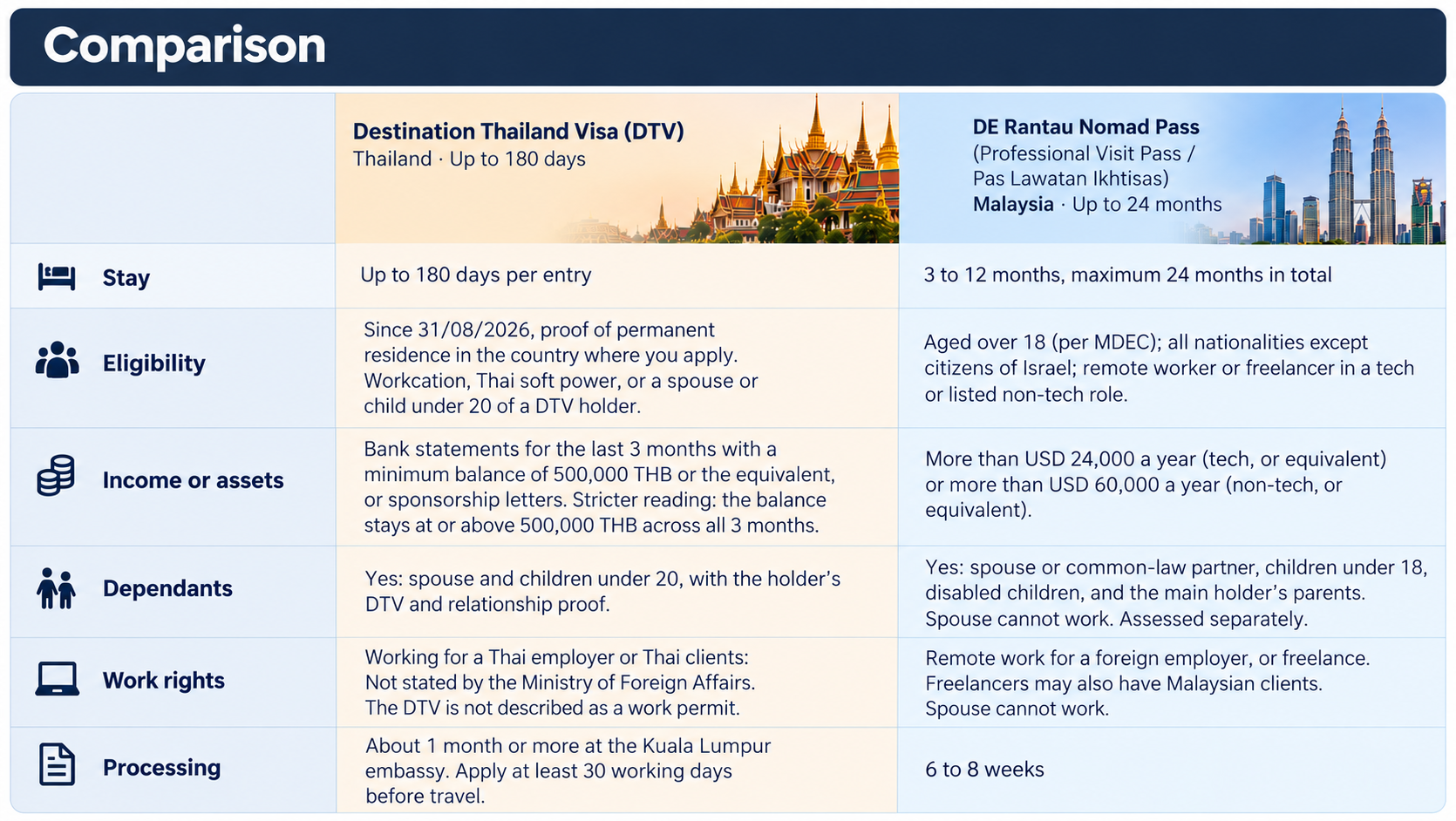
This is not legal advice, and requirements can change, so you should always check the latest official guidance before you apply.
What kind of remote worker are you?
A lot of people think the big question is Malaysia versus Thailand, but the first question is usually simpler. Are you a remote employee, a freelancer, or somewhere in between.
If you are employed, you usually have a contract, payslips, and a neat story you can tell with documents. If you freelance or contract, you might earn well, but your income can look less straightforward on paper, especially if you have multiple clients, irregular invoices, or income that comes in waves. Neither is better, but it changes what “easy” feels like when you are gathering evidence for an application.
What you will be asked to prove
Most remote work visa routes involve the same broad categories of proof. You are proving who you are, proving you can support yourself, and proving that your work situation is real.
The details vary, but it helps to think in categories rather than a long checklist. You are likely to deal with documents that show identity, documents that support your work situation, and documents that support your finances. People often underestimate how long it takes to gather these properly, especially when something needs to be reissued, translated, certified, or provided in a specific format.
How long you can stay
Visa language is not designed to be friendly, and it is common for people to mix up different time periods. Some visas have a validity period that is not the same thing as the length of stay you are granted each time you enter, and those details matter when you are trying to plan a life.
If you are dreaming of renting a place, setting up a routine, and not thinking about your status every few weeks, you want to understand what the route allows in practice. If you are treating the move as a trial run, you might be fine with more admin and more flexibility. The right choice depends on what you want your year to feel like.
Whether you are bringing someone with you, and what that changes
If you are moving with a partner or children, you should treat dependant rules as a core part of the decision, not a footnote. It is not only about whether dependants are allowed, but also what evidence is required, what ongoing conditions apply, and what happens if the main applicant’s situation changes.
Even if you are not moving with children, couples often find that the visa plan becomes the foundation of their stability, because one person’s route can quietly determine whether the other person feels settled or stuck.
The process itself, and how much of it is truly online
People often describe visas as “easy” or “hard,” but what they usually mean is the process. Some routes are more digital, some involve more physical steps, and some require more back and forth with documents. This matters if you are trying to time your move around a lease ending, a school term, a work project, or simply your own energy for admin.
If you are choosing between Malaysia and Thailand, it is worth looking past the headline and asking a simple question. How much of the process can you actually do remotely, and what steps still require appointments, originals, or in person visits.
A simple way to decide without overthinking it
If you are choosing between Malaysia and Thailand for remote work, try this. Pick the route that fits your paperwork and your timeline first, then choose the city and lifestyle second. It sounds less romantic, but it saves you from falling in love with a plan that turns out to be awkward to execute.
If the dream is starting to turn into a plan, and you want a clearer path through the visa questions and the practical steps, you can explore your options and get guidance at SojournHub. It is built for people who are serious about moving, not just browsing, and it helps you go from “maybe someday” to a move you can actually follow through on.
Limitations
This is information, not legal advice. SojournHub may be able to help with a route mentioned here. Approval is never guaranteed.
Corrections
If a sentence is wrong, write to support@sojournhub.io or use the contact page. Name the article and the sentence. A material correction keeps the same address and changes the updated date. Until that correction is published, the article can be returned to draft so it leaves this page.
Contact us